
Does a Chemical Wash Remove Mould and Bacteria?
Yes — an aircon chemical wash removes up to 99% of mould and bacteria and clears musty odours at the source.
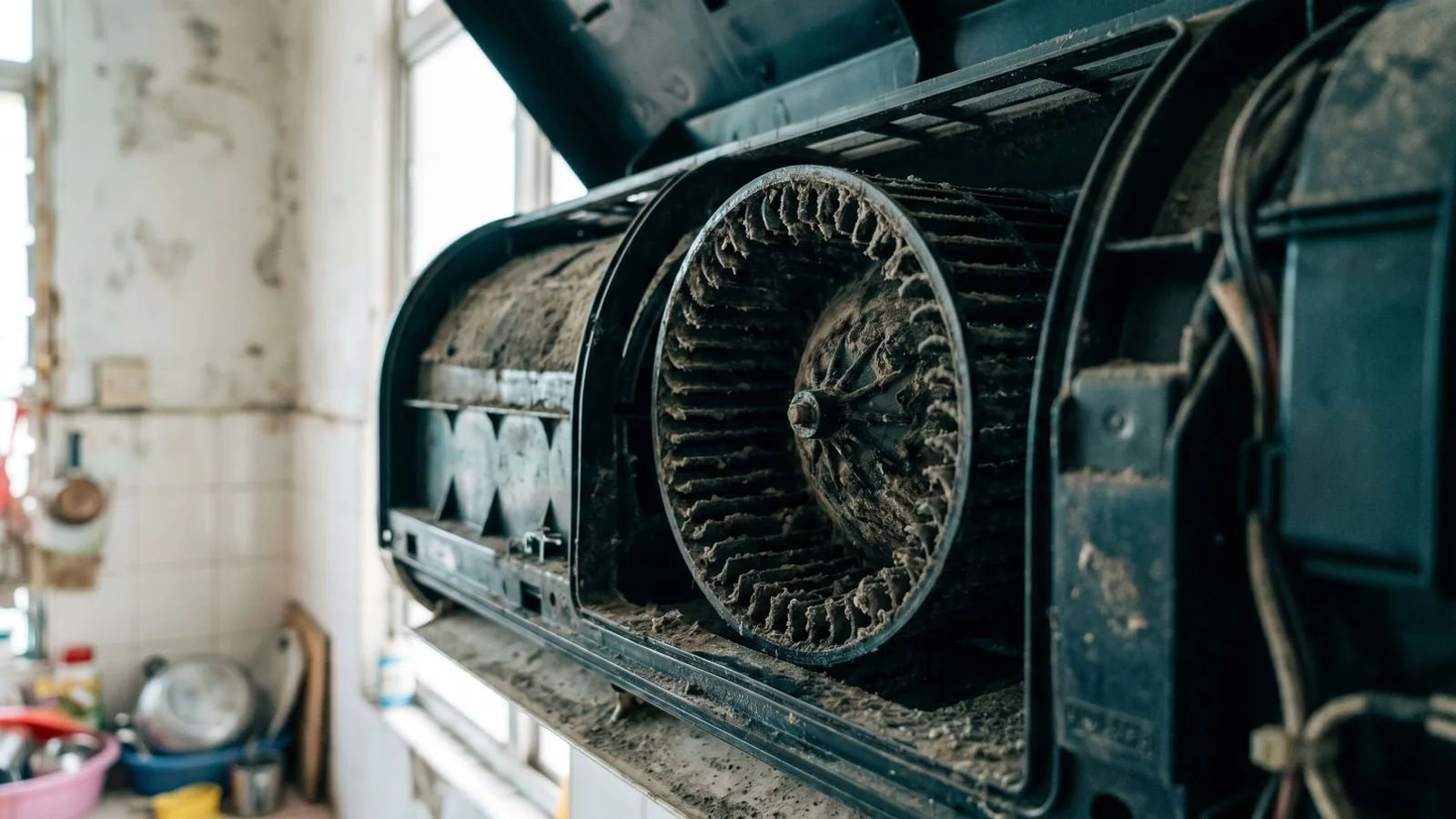
From what I have seen working on units across Penang, that musty smell hitting your nose the second the aircon turns on is a clear warning sign. You are smelling an active colony of mould. It thrives in the dark spaces you cannot easily inspect, like the evaporator coil, the blower wheel, and the inside of the water tray.
This is exactly why property owners want to know exactly how a chemical wash remove mould bacteria so effectively.
We often explain that standard wiping simply cannot reach the core of the infection. Our step-by-step chemical wash process guide shows how each part gets treated. Let’s look at the science behind the smell, how the cleaning process actually works, and the most practical ways to handle regrowth.
Where the mould grows
The indoor air handler is essentially a perfect incubator for fungal growth. Research from Universiti Kebangsaan Malaysia actually found that over 83 percent of Malaysian homes deal with severe indoor mould contamination.
Three specific conditions feed these colonies:
- Constant moisture: The evaporator coil stays wet during active cooling, and the drainage tray catches all the continuous runoff.
- Tropical temperatures: Even while cooling, our year-round 70 to 90 percent humidity keeps internal components in the ideal damp range.
- Endless food supply: The system constantly pulls in dust, microscopic skin cells, and airborne particulates from your living space.
Our technicians frequently see specific strains like Aspergillus and Cladosporium taking over units. Spores from these species can germinate in just 24 to 48 hours under the right conditions.
In the heavy humidity of Penang, a neglected unit will develop a thick biological coating in a matter of weeks. The first symptom is always the sour smell, closely followed by dropping airflow as the blower wheel gets choked.
What the chemical actually does
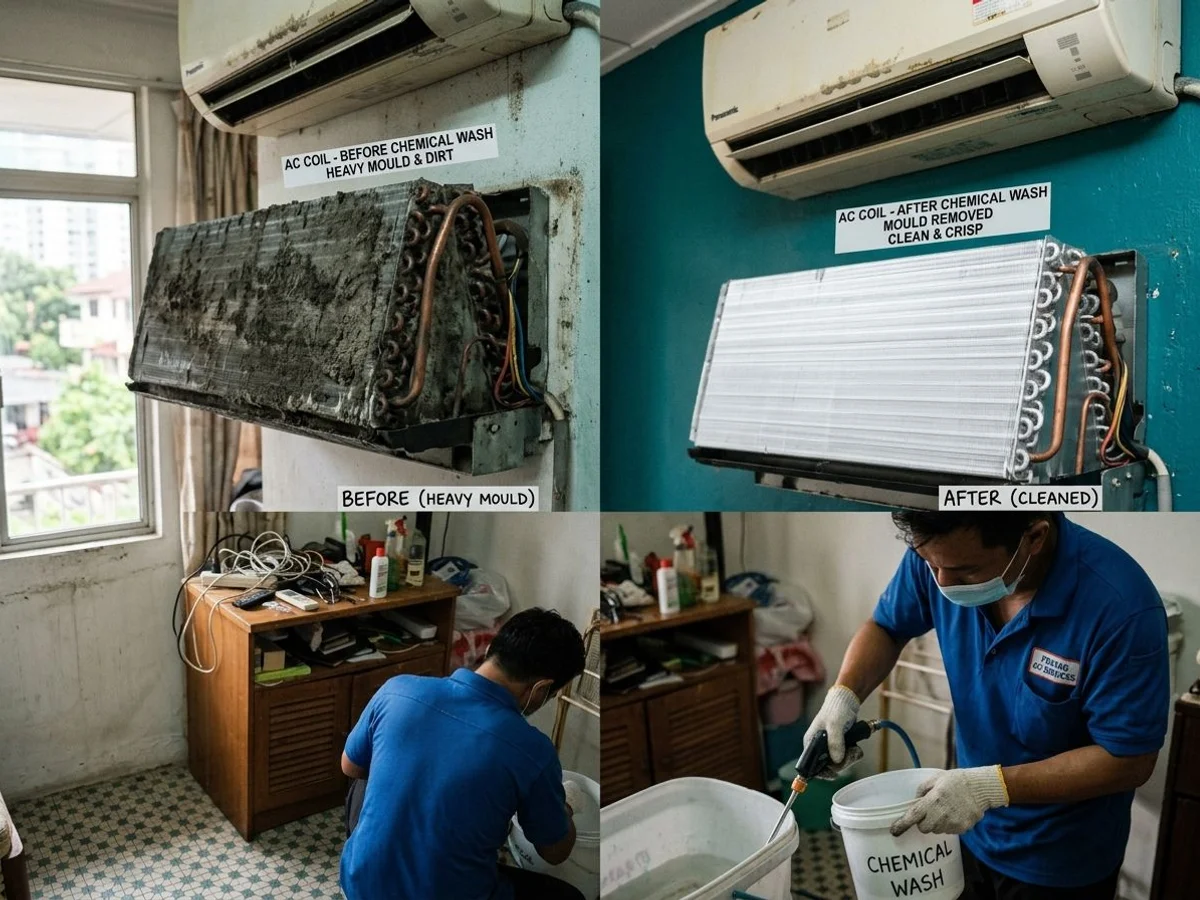
The coil cleaner used in a proper service is an alkaline solution, typically formulated with sodium hydroxide. It sits at a high pH level around 11 to 13, which makes it incredibly effective without the corrosive dangers of acid cleaners.
This specialized chemical performs three vital jobs for effective aircon bacteria cleaning:
- Dissolves the bonded layer: The alkaline action breaks down the stubborn grime, mould, and biological growth adhered directly to the delicate coil fins.
- Penetrates cell walls: It completely breaches the defenses of both bacteria and fungal spores to neutralize the active colony.
- Rinses cleanly: The solution washes away entirely under pressurised water to leave zero chemical residue behind.
We rely on this method because independent industry testing consistently shows 99 percent bacteria elimination after a thorough wash. The remaining one percent gets cleared by ongoing operation as the freshly cleaned coil dries out, temporarily disrupting the damp environment the mould needs.
What it does NOT do
A chemical wash strips away existing contamination, but it does not act as a permanent shield against future regrowth. Fungal spores are a natural part of the tropical air in Penang.
Our team wants to be entirely transparent about the realities of local maintenance.
| Maintenance Stage | Typical Timeline in Malaysia |
|---|---|
| Spore Germination | 24 to 48 hours after exposure to dampness |
| Visible Regrowth | 3 to 6 weeks on unwashed coils |
| Clean Operation | 6 to 12 months after a proper alkaline wash |
Anyone selling a permanent fix for indoor aircon mould removal in a tropical climate is severely overselling their service. The only realistic answer is maintaining a strict, regular wash cadence based on your specific usage.
The smell explained
Industry professionals actually refer to that sour, “old socks” odor as Dirty Sock Syndrome. It happens when active biological growth on your coils begins aerosolising.
We see this exact sequence of events happen inside infected units:
- Dust Accumulates: Dead skin cells and household dust get trapped on the wet coil.
- Bacteria Feeds: Microbes consume this organic matter in the dark, damp environment.
- VOCs Release: The bacteria off-gas Volatile Organic Compounds.
- Smell Spreads: The AC blower pushes these stinky gases straight into your bedroom.
After a thorough wash, the biological source of these gases is completely removed.
The smell will vanish immediately, rather than fading away gradually. The air remains fresh until the colony eventually re-establishes itself several months down the line.

Why this matters for allergy-sensitive homes
Recent 2026 data shows that roughly two million Malaysians suffer from asthma, making indoor air quality a serious health priority. The mould and bacteria on a neglected AC coil can act as a severe respiratory trigger.
The unit functions as a recirculating air pump. Everything growing on that damp coil gets distributed straight into the lungs of anyone in the room during every single cycle.
Protective Maintenance Options
Our customers with allergy-sensitive children or severe asthma often request a tighter 4-month cleaning cycle as a medical precaution. The cost of this extra frequency is modest, but the difference in daily breathing comfort is highly noticeable.
If you need a chemical-free deep-clean option for a highly sensitive household, just ask about high-temperature steam cleaning. The biological clearing effectiveness is extremely comparable, and the pricing remains similar.
Beyond mould: what else gets cleaned
Fungal growth is only half the problem hiding inside a dirty unit. An alkaline wash also clears out a surprising amount of daily household pollution.
The deep cleaning process targets:
- Algae buildup: The slime inside the water tray and drainage line is the primary cause of sudden indoor water leaks.
- Bonded dust and PM2.5: It removes the microscopic particulate matter stuck to the coil fins that regular surface wiping cannot shift.
- Tobacco residue: The sticky tar and smoke particles trapped inside the system get dissolved completely.
- Pet dander: It flushes out the fine animal hair that inevitably works its way past the primary filter and into the blower motor.
We know that combining these benefits results in significantly cleaner air and much stronger cooling performance. The unit stops straining to push air through a clogged system, which immediately lowers your monthly electricity consumption.
Booking
If you have been smelling something unpleasant from your wall unit, do not wait for the airflow to drop entirely.
Our scheduling team is ready to help you fix the problem fast.
WhatsApp a quick photo of your unit and describe the odor so they can check availability.
The team will reply shortly with the very next available slot and a rough estimate.
Review the chemical wash service page for all current pricing details and package options.