
R32 vs R410A: which aircon refrigerant is better?
A plain comparison of R32 and R410A refrigerants, what sets them apart on efficiency, environmental impact, and safety, and how to tell which one your aircon uses.
If you have looked into servicing or replacing your air conditioner, you have probably seen the labels R32 and R410A and wondered which one matters. These are the two refrigerants you will come across most often in Malaysian homes, and they behave differently enough that it is worth understanding the basics before you buy or recharge a unit.
Here is a straightforward comparison from the PG1 Aircond team.
What a refrigerant actually does
Refrigerant is the fluid that carries heat out of your room. It absorbs heat indoors as it evaporates, the compressor pressurises it, and it releases that heat outside before circulating back in. Without the right refrigerant at the right charge, the whole cycle falls apart and the unit cannot cool.
Different refrigerants have different strengths, and the two that dominate the market today are R32 and R410A.
R32, the modern standard
R32 is a single-component hydrofluorocarbon (HFC) gas that has become the default in most new air conditioners.
Its main advantages are efficiency and a lower environmental footprint. R32 has a global warming potential of around 675, which is roughly a third of R410A’s, and because it is a single chemical rather than a blend, it is simpler to recharge accurately and to recycle. It also tends to deliver strong cooling capacity, which helps keep running costs down.
The one thing to know is that R32 is classed as A2L, meaning mildly flammable. Inside a correctly installed unit this is not a concern in everyday use, but it is a good reason to leave refrigerant work to a trained technician. You will find R32 in newer units from brands like Daikin, Mitsubishi, LG, Hitachi, Acson, and Hisense.
R410A, the established option
R410A is a blend of two chemicals, difluoromethane and pentafluoroethane, and it has been the workhorse refrigerant in air conditioners for many years.
It is non-flammable, classed as A1, and it does not deplete the ozone layer. It runs at a higher pressure than older refrigerants, with a boiling point around minus 51.7 degrees Celsius, and it cools effectively. Its main drawback is environmental: its global warming potential is around 2,088, far higher than R32, which is why manufacturers are gradually phasing it out of new models. If your air conditioner is a few years old, there is a good chance it runs on R410A.
R32 vs R410A at a glance
| Feature | R32 | R410A |
|---|---|---|
| Type | Single-component HFC | Blend of two HFCs |
| Global warming potential | Around 675 | Around 2,088 |
| Energy efficiency | Higher | Good |
| Flammability | A2L (mildly flammable) | A1 (non-flammable) |
| Recharge and recycling | Simpler (single gas) | More complex (blend) |
| Typical units | Newer models | Older models |
So which is better?
For a new purchase, R32 is the sensible choice for most homes. The efficiency gain helps your TNB bill, and the lower global warming potential matches where the industry is heading.
For an existing unit, the better refrigerant is simply the one your system was designed for. You cannot swap between them, and you must never mix them, because the two run at different pressures and the wrong gas will damage the unit. The right move is always to recharge with the exact refrigerant on the unit’s nameplate.
How to tell which one your unit uses
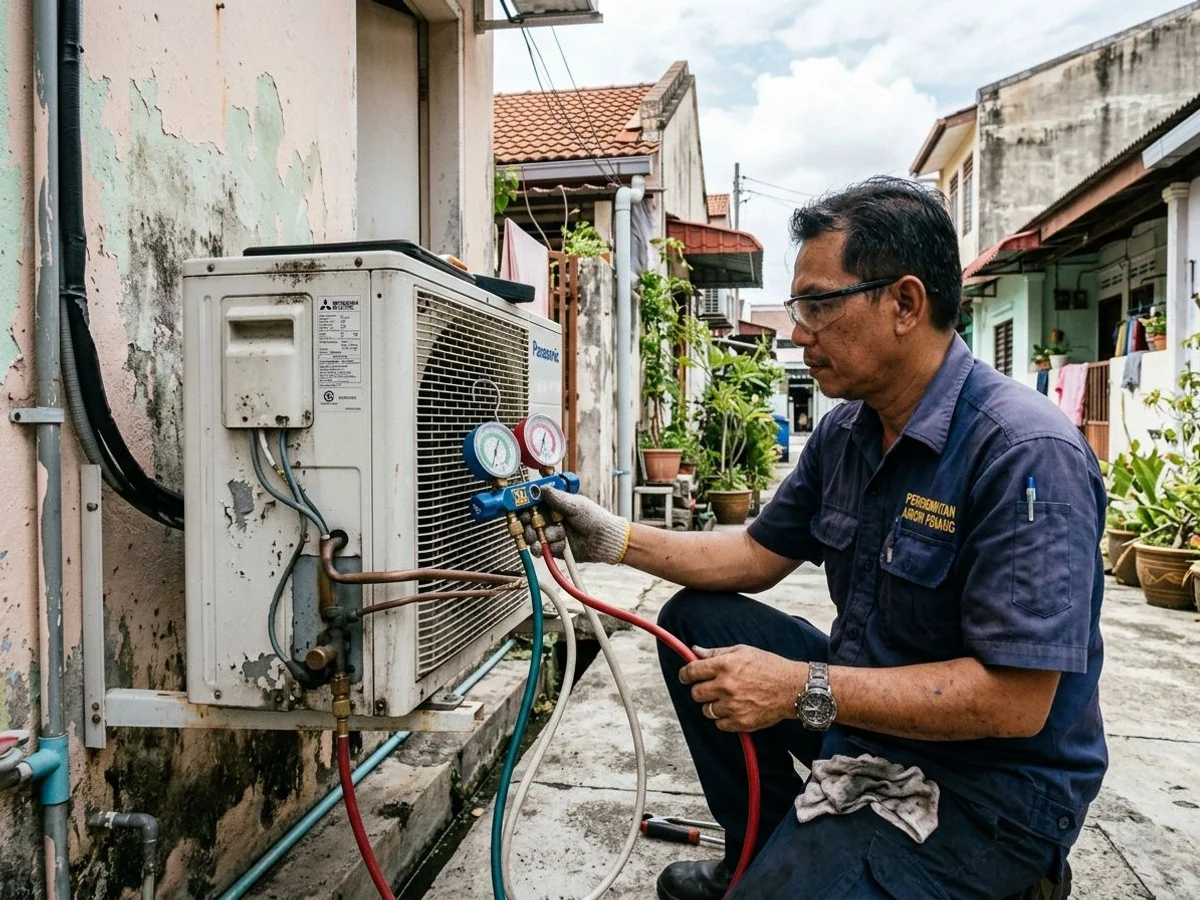
The quickest way is to check the specification sticker on the indoor or outdoor unit, which states the refrigerant type and charge weight.
If you are not sure, our technician identifies it on site before any gas work, so the system is recharged correctly. If your unit is low on refrigerant in the first place, remember that it points to a leak rather than normal use. Our guide on spotting a refrigerant leak explains the warning signs, and a proper aircon gas top up always means finding and sealing that leak before recharging with the right gas.