
Aircon gas leak: the signs, the causes, and why it matters
How to spot an aircon refrigerant leak, what actually causes the gas to escape, and why topping it up without finding the leak never fixes the problem.
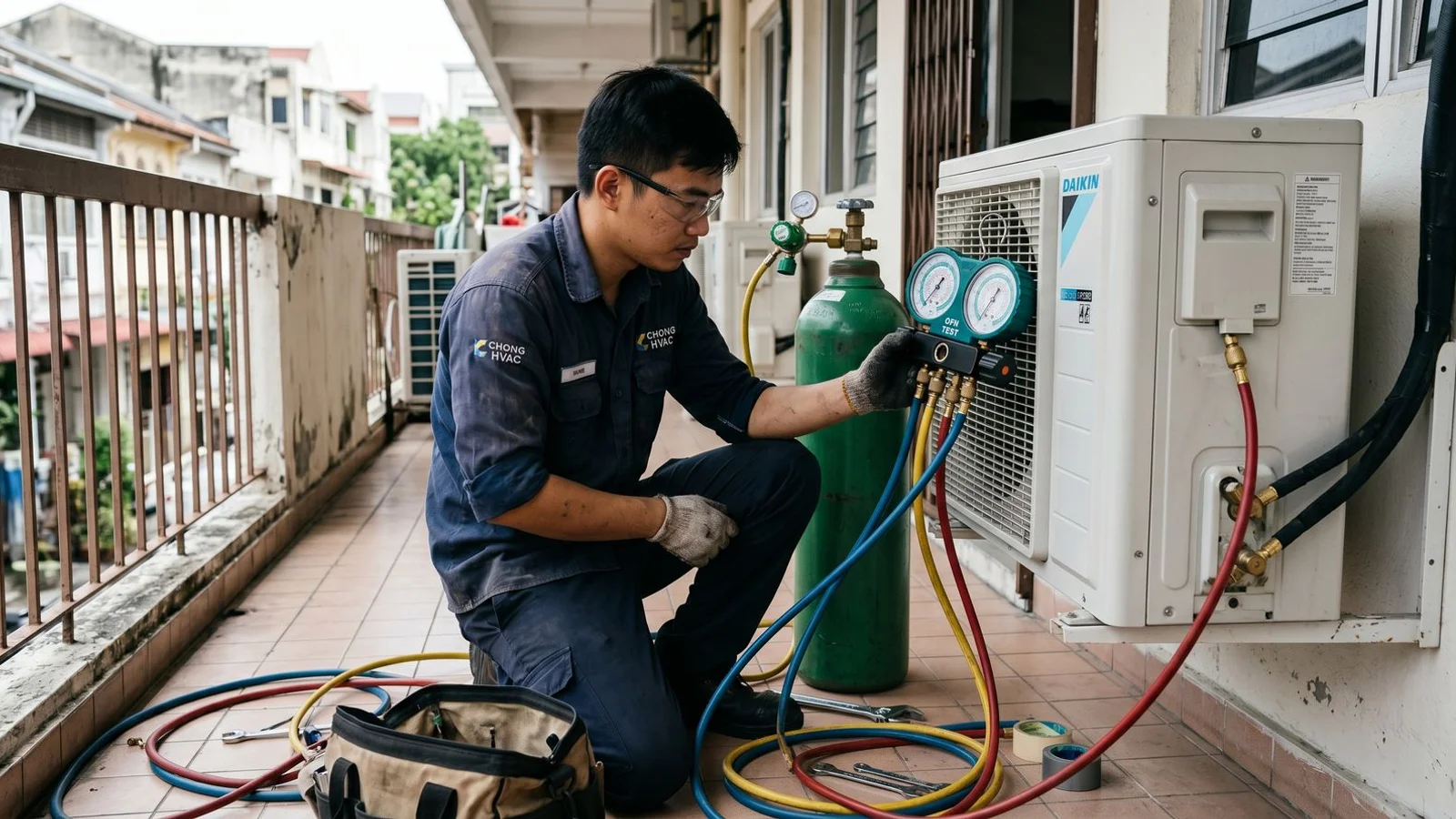
A refrigerant leak is one of the most common faults we are called out to in Penang, and also one of the most misunderstood. People often assume the gas simply runs low over time and needs topping up. It does not work that way, and understanding why will save you from paying for the same problem twice.
Here is how to recognise a leak, what causes it, and why it needs proper attention rather than a quick refill.
Five signs of an aircon gas leak
A leak rarely announces itself clearly, but these are the signals worth watching for:
- A hissing sound. The refrigerant in your system is under pressure, so when it escapes through a crack or a loose joint it can make a faint hissing noise. It is one of the clearer signs.
- Weak cooling or warm air. When the charge drops, the unit cannot cool properly. You may notice it blowing room-temperature air, taking far longer to cool, or short cycling, which is switching on and off in quick bursts.
- Ice on the coil or pipe. A low charge can cause the evaporator coil to freeze. If you see ice forming, switch the unit off and let it thaw, because running it iced up strains the system. A frozen coil is closely linked to an aircon that is not cooling.
- A higher TNB bill. A unit that is short on refrigerant works much harder to deliver the same cooling, so your electricity use climbs even though nothing else has changed.
- A faint sweet smell. Refrigerant can give off a sweet, chloroform-like odour near the unit. Not every leak smells, so treat this as a supporting clue rather than proof.
What causes refrigerant to leak
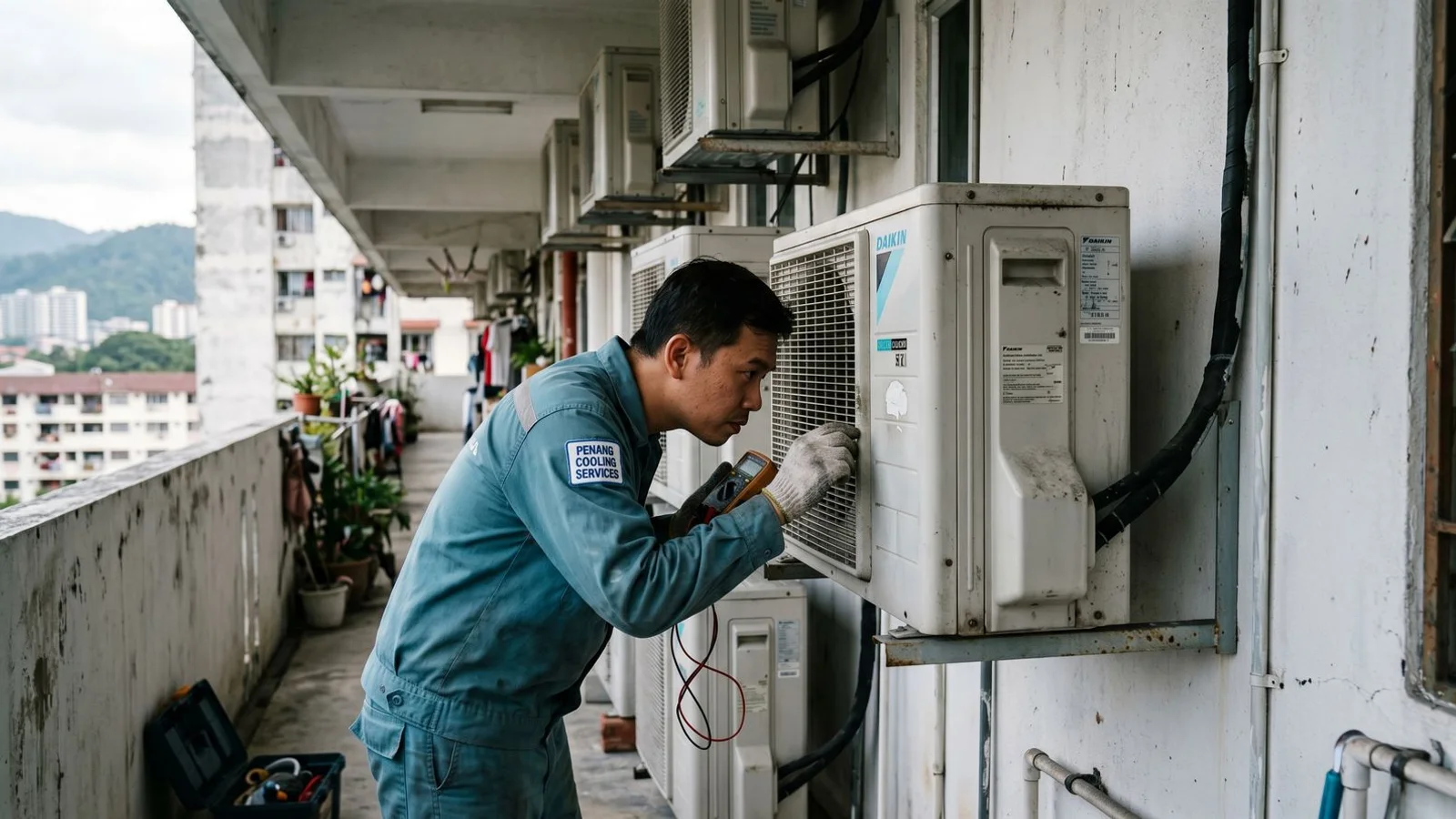
Refrigerant escapes through a physical fault somewhere in the sealed loop. The usual culprits are:
- Corrosion. Over time, metal exposed to moisture and airborne chemicals slowly corrodes, and tiny pinholes form in the coil or pipework. Penang’s humid, coastal air speeds this up, especially for units near the sea.
- Mechanical damage to the refrigerant lines. The copper lines that carry refrigerant between the indoor and outdoor units can be knocked, kinked, or worn, particularly where they pass through an exterior wall.
- A faulty compressor. The compressor pressurises the refrigerant, and a fault or worn seal there can let gas escape.
- A failing Schrader valve. This small valve near the compressor regulates refrigerant flow. If its seal or the valve itself fails, gas leaks out steadily.
- Worn seals and loose connections. The joints and seals around the service valves loosen or perish with age, which lets pressure and refrigerant drop away.
Why you should not ignore it
A small leak rarely fixes itself, and it tends to get more expensive the longer it runs.
The unit keeps straining to cool with too little refrigerant, which drives up your power bill and puts the compressor under constant stress. A burnt-out compressor is one of the costliest repairs on an air conditioner, and it is often the end of the road for an older unit. There is also the environmental cost, since refrigerants are potent greenhouse gases when released, and in a small sealed room a significant leak can displace oxygen. The R32 used in most newer units is also classed as mildly flammable, which is another reason to take a leak seriously rather than leave it weeping for months.
What to do about it
If you suspect a leak, switch the unit off rather than running it half-charged, and resist the temptation to just have the gas refilled.
The proper fix is to find the leak, seal it, and only then recharge the system to the manufacturer’s specified weight. We pressure-test the system to locate the fault, repair it, vacuum the line where the job calls for it, and recharge correctly before running a cooling test so you can see the result.
That is exactly what a proper aircon gas top up involves at PG1 Aircond. We never simply top up and walk away, because gas that leaked once will leak again. Send us a WhatsApp message describing what your unit is doing, and we will diagnose whether you are genuinely dealing with a leak or something else entirely.