
Aircon Blowing Warm Air — Causes and Fixes
Aircon blowing warm air? Low refrigerant, dirty filter, compressor fault, or thermostat. Here's the diagnostic order.
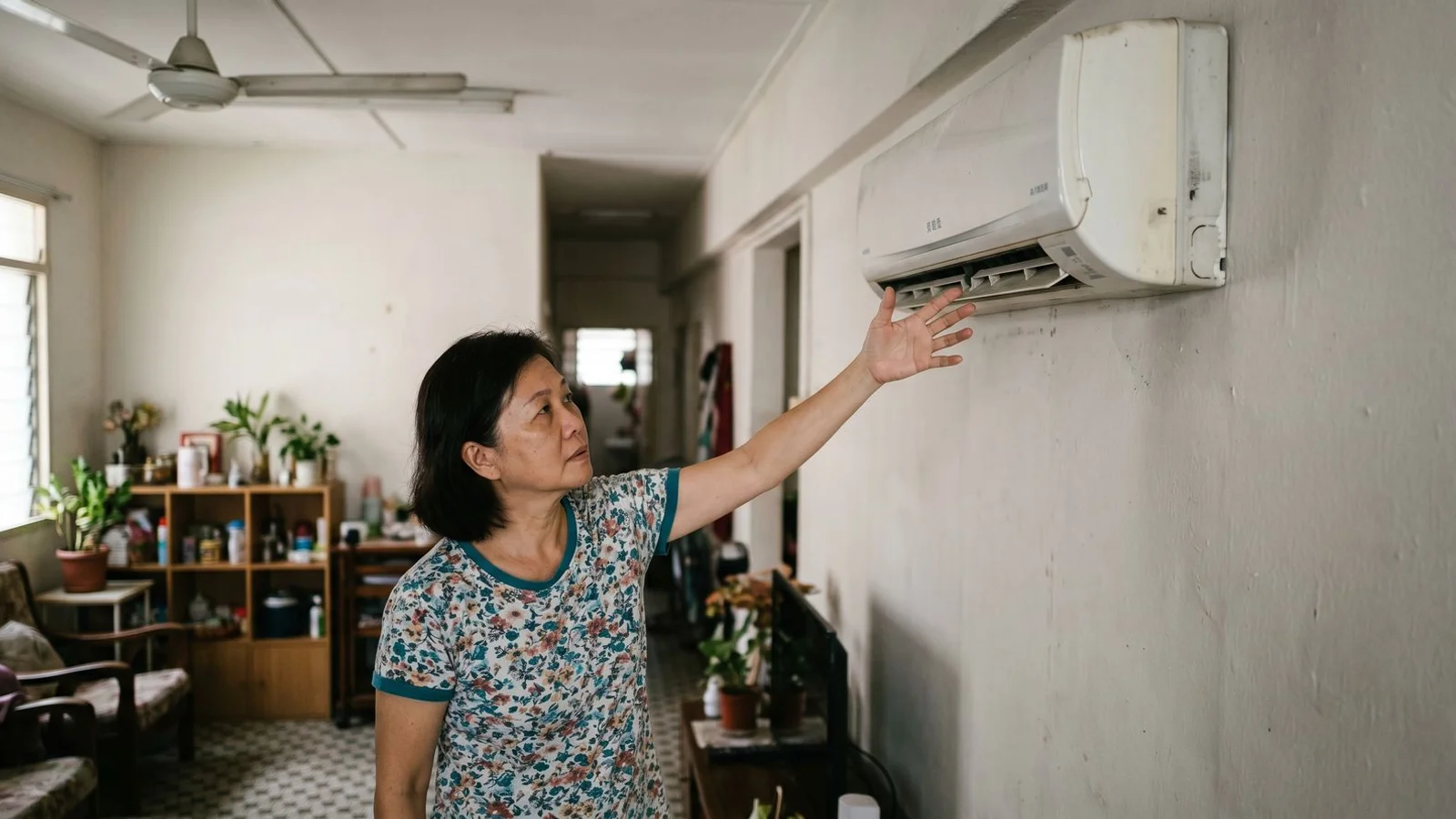
“My aircon is running but the air is warm.”
That specific complaint is the most common operational issue we see across Penang.
Our team has handled thousands of these exact emergency calls, and the heavy coastal humidity often masks the true underlying mechanical faults. Solving an aircon blowing warm air does not always require a massive, expensive repair bill.
We want to share the exact diagnostic checklist our senior technicians use daily. Let’s look at the data, what it actually tells us, and explore a few practical ways to respond. If the fault turns out to be major, our aircon repair vs replacement guide walks through the cost trade-off.
Self-check first (2 minutes)
Before you call anyone, run through these three basic checks. This simple routine rules out about 30 percent of warm air calls we receive in Malaysia.
- Mode is Cool, not Fan or Dry. Cool mode is represented by the snowflake icon on most remotes, including popular models from Daikin and Panasonic. Fan mode just circulates room-temperature air without activating the outdoor compressor.
- Set temperature is below the room temperature. A system will only cool if the target is lower than the ambient heat. If your room sits at 28°C and you have set the remote to 26°C, the unit will engage.
- Filter is clean. Take the plastic mesh filter out of the indoor unit. If it is visibly caked with dust, rinse it under lukewarm water, dry it completely, and run the system for an hour to see if cooling returns.
Sudden vs gradual
The most useful diagnostic question is whether the aircon not cold air issue started suddenly or gradually. A sudden failure usually points to an electrical or pressure fault. Gradual decline typically indicates a severe maintenance backlog.
- Sudden (Overnight or under 24 hours): Low refrigerant from a burst leak, tripped circuit breaker, failed starting capacitor, or a sudden compressor fault.
- Gradual (Over 1 to 3 months): Caked and dirty filters, severely fouled evaporator coils, or thermostat sensor drift.
Cause 1: Low refrigerant (gas leak)
Your system’s refrigerant acts as the vital heat transfer medium. When a gas leak occurs, the entire cooling cycle breaks down rapidly.
- Symptoms: Cooling worked perfectly last week, but today the air is barely cooler than room temperature. You can sometimes see ice forming on the indoor copper coil if airflow is also severely restricted.
- Why: Refrigerant never simply gets used up, as your unit is a fully sealed loop. If the pressure drops, the gas leaked out. These leaks usually occur at a loose flare joint between the indoor and outdoor piping, or at a tiny coil pinhole on older systems.
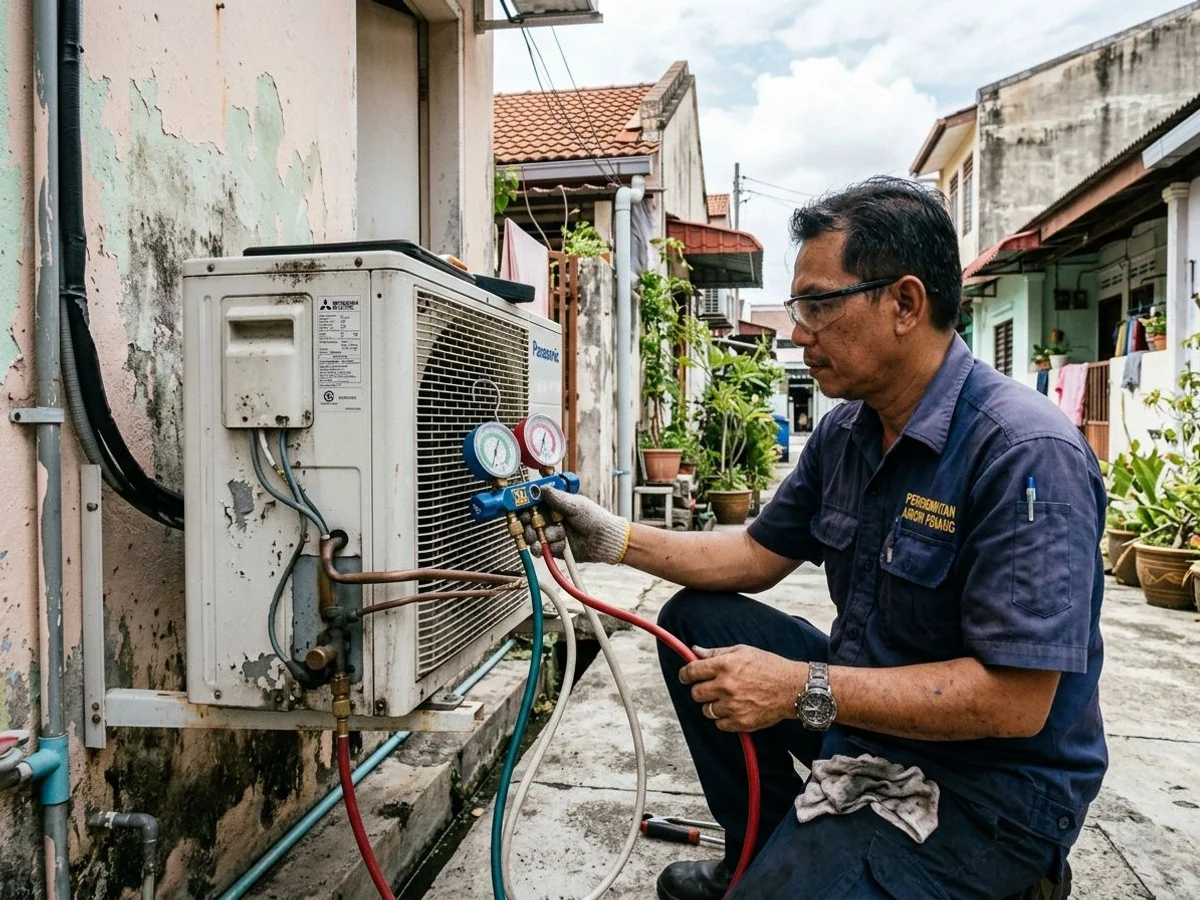
- The fix: Our certified technicians measure the system’s exact refrigerant pressure in under 30 seconds using specialised digital gauges. If the levels read low, trace testing begins using an electronic detector or a rigorous Oxygen Free Nitrogen pressure test. We then seal the exact leak point, evacuate the line, and recharge it with the correct R32 or R410a refrigerant. Mixing these two different gases can destroy a compressor, so professional handling is non-negotiable.
- Cost: A standard flare joint re-tighten combined with a full system top-up generally runs RM200 to RM350. Coil pinhole repairs vary widely based on the specific location of the copper damage.
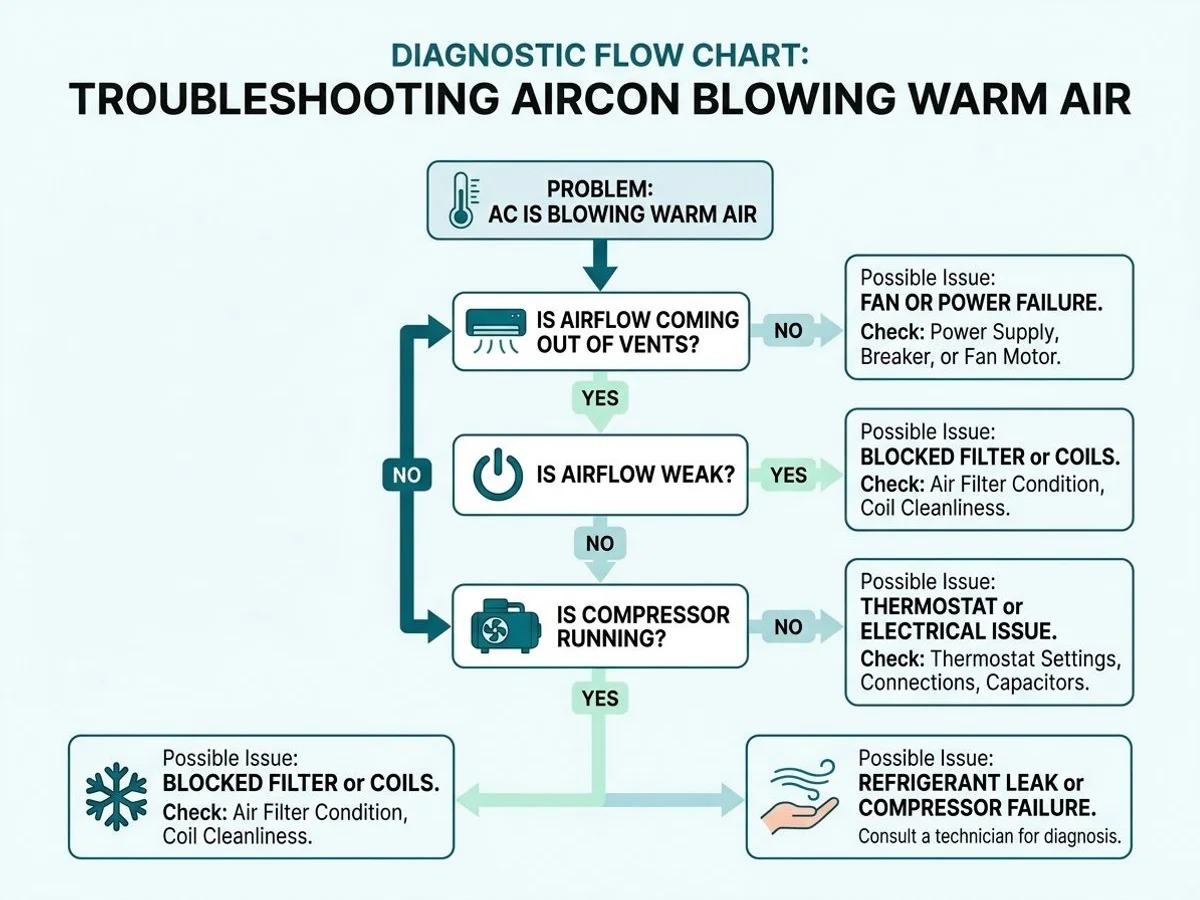
Common Mistake: Never pay for a simple gas top-up without insisting on a proper leak detection test first. Adding new gas alone is merely a two-week patch, as the expensive refrigerant will continuously escape through the exact same hole.
Cause 2: Fouled coil (gradual warm air)
This issue develops over weeks or months as cooling performance steadily drops off. The unit still pushes out air, but cooling a standard bedroom takes noticeably longer. You will often detect a damp, sour smell upon switch-on.
The Impact of Biological Build-up
Mould, bacteria, and dense grime build up directly on the evaporator coil over time. This biological layer acts as an insulator, completely blocking heat transfer from the room to the refrigerant. According to standard HVAC efficiency studies, a heavily fouled coil can slash a system’s cooling capacity by up to 30 percent while driving up electricity consumption. Our local Penang humidity, often exceeding 80 percent, creates the absolute perfect breeding ground for this thick fungal growth.
Restoration and Washing
We utilise a professional chemical wash to tackle this specific blockage. This targeted alkaline treatment dissolves the stubborn grime and restores most units to near-original factory cooling capacity. If a standard wash fails to clear the deepest blockages, a complete chemical overhaul becomes the necessary next step.
Cause 3: Compressor fault
A compressor acts as the beating heart of your entire cooling system. When it fails, you face a significant and immediate disruption to your home comfort.
Identifying Compressor Failure
The outdoor unit will usually refuse to start entirely, or it will attempt to spin up and immediately trip your household circuit breaker. The indoor unit might continue running its blower fan, but absolutely no cold air will emerge. You might also hear a harsh, mechanical grinding noise coming from the outdoor casing just before it shuts down entirely.
Root Causes of Seizure
Compressor failure or mechanical seizure happens frequently on systems older than ten years. Running your system with low refrigerant for extended periods acts as a major catalyst for this severe damage. The R32 or R410a refrigerant actually cools the heavy-duty compressor motor during operation, so running the machine dry causes rapid, fatal overheating.
Repair Costs vs. Replacement
Our teams handle compressor replacements ranging from RM1,500 to RM3,000, depending heavily on your unit’s brand and whether it uses modern Inverter technology. Replacing the entire condensing unit often proves much more economical for hardware past its tenth year. We will always map out the exact mathematics so you can make a clear, financially sound decision.
Cause 4: Capacitor failure
Electrical starting components are highly vulnerable to the constant, extreme heat of the Malaysian climate. This single component is responsible for a massive percentage of sudden breakdown calls.
- Symptoms: The outdoor unit attempts to start but only produces a low humming sound without actually spinning up. In some cases, the outdoor exhaust fan engages correctly but the heavy compressor remains completely silent.
- Why: The starting capacitor acts as a powerful, short-term battery that delivers the massive electrical kick needed to start the compressor and fan motors. These cylindrical components naturally degrade over 5 to 10 years, and constant exposure to high ambient outdoor temperatures accelerates their failure. A failed capacitor often bulges slightly at the top or leaks a sticky fluid.
- The fix: A straightforward capacitor replacement solves this problem immediately. Our technicians test the exact microfarad output using a professional multimeter, replacing faulty parts for roughly RM150 to RM300 depending on the system size. This replacement is a remarkably fast process, bringing your home back to full, freezing cooling within an hour.
Cause 5: Thermostat sensor drift
Temperature sensors act as the brain of your indoor climate control, telling the system exactly when to work and when to rest.
- Symptoms: Your system cycles erratically, sometimes blasting cold air and other times doing nothing at all. The remote control displays a low target temperature, but the machine acts as if the room has already reached that icy baseline.
- Why: The tiny thermistor temperature sensor inside the indoor unit relies on electrical resistance to gauge ambient heat. After 5 to 7 years of constant use, these sensitive electronic components experience natural drift and send wildly inaccurate readings to the main control board.
- The fix: Swapping out the degraded sensor for a fresh one is a rapid, straightforward procedure. This highly precise repair typically costs between RM150 and RM250, permanently fixing the erratic cycling.
Comparison of Common Component Fixes
| Faulty Component | Typical Lifespan | Average Repair Cost (MYR) | Repair Timeframe |
|---|---|---|---|
| Starting Capacitor | 5 to 10 years | RM150 to RM300 | Under 1 hour |
| Thermostat Sensor | 5 to 7 years | RM150 to RM250 | Under 1 hour |
| Compressor Unit | 10 to 15 years | RM1,500 to RM3,000 | 1 to 2 days |
Cause 6: Frozen coil (downstream of other issues)
It seems completely counter-intuitive, but a block of solid ice inside your machine is actually a leading cause of warm air.
- Symptoms: The system cooled perfectly a few days ago, but the performance suddenly plummeted today. You can physically see a thick layer of white ice forming on the indoor copper coils right through the plastic air grille.
- Why: Two primary culprits cause this dramatic freezing: severely restricted airflow from a blocked filter, or incredibly low refrigerant pressure. Both scenarios prevent the icy coils from absorbing ambient room heat. The normal condensation present on the chilled metal freezes solid, creating a thick ice barrier that blocks even more airflow and aggressively compounds the problem.
- The fix: Turn off the cooling function immediately and run the system on fan-only mode for 30 to 60 minutes to safely thaw the block of ice. Our team then steps in to permanently resolve the underlying root cause. The necessary fix might involve deep-cleaning the fouled filter, performing a restorative chemical wash, or completing a strict refrigerant leak repair.
The diagnostic order we run
When our service teams arrive on-site for a warm air complaint, we never rely on guesswork. We follow a strict, standardised diagnostic checklist to pinpoint the exact failure.
- Confirm the customer’s settings. We quickly check the remote mode and target temperature against the ambient room heat.
- Examine airflow components. Physical filters require a visual inspection, and the visible evaporator coil gets checked for thick biofilm or solid ice.
- Test electrical stability. We use a professional digital multimeter to measure the exact microfarad output of the starting capacitor and check the contactor’s electrical continuity.
- Measure system pressure. Digital manifold gauges connect directly to the outdoor service valves to check the exact refrigerant pressure in PSI.
- Verify sensor accuracy. We test the internal thermostat sensor’s current resistance reading against the actual ambient room temperature.
- Inspect mechanical operation. The outdoor condensing unit undergoes a close visual check for unexpected ice buildup, harsh compressor grinding noises, and proper exhaust fan operation.
Most warm air diagnoses reach a definitive conclusion within 15 minutes. We execute the necessary fix immediately if the problem stems from a dirty filter, blown capacitor, drifting sensor, or a simple accessible leak. Larger mechanical jobs always receive a transparent, written quote before any tools touch your equipment.
Booking
Dealing with a broken air conditioner in the middle of a hot Penang afternoon is incredibly frustrating. We are fully equipped to restore your home’s comfort rapidly and professionally.
Book a repair with our dedicated local team today. Send a quick message to our WhatsApp with a few key details: when the cooling issue started, whether the failure felt sudden or gradual, any strange noises coming from the outdoor compressor, and a quick photo of the indoor unit. Our scheduling staff will come straight back with the absolute earliest available time slot and a highly accurate cost range for your peace of mind.