
Aircon Repair vs Replacement — When to Replace
Repair or replace your aircon? Age and cost thresholds, repeat-fault signals, and the efficiency gains of a new inverter.
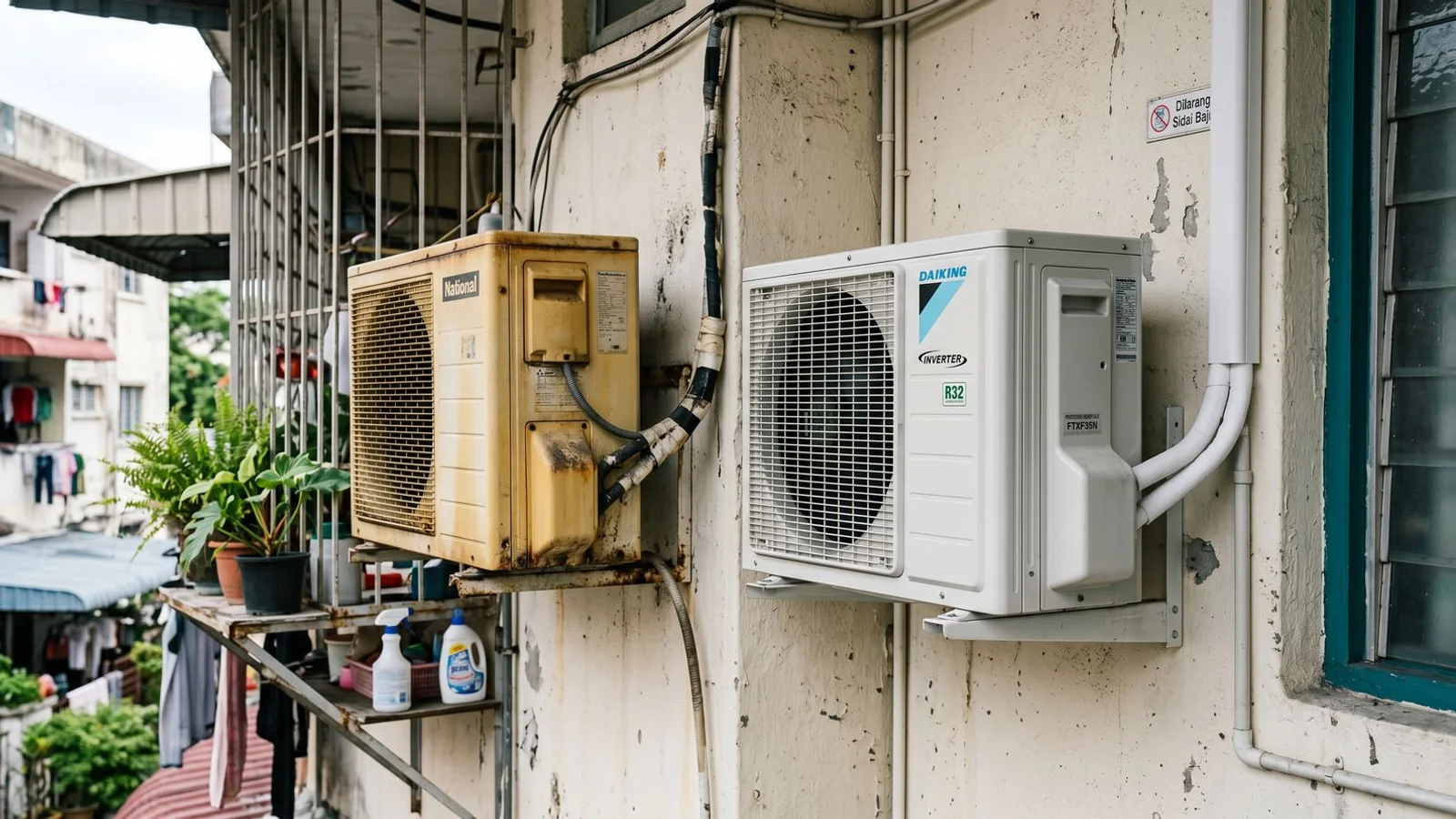
When your quote comes back at RM1,200, the immediate question is rarely about affordability.
The real debate is about aircon repair vs replacement and whether the fix is worth the investment.
We at PG1 Aircond have spent over 15 years diagnosing these exact dilemmas for homeowners across Penang. Making the call requires a clear look at your unit’s current state and future TNB running costs.
A quick fix sometimes ends up wasting money if the system is already failing.
Our technicians use a specific set of rules to determine the most cost-effective path forward. Before you decide, it helps to know what to expect from an aircon repair so you can compare the real cost of fixing versus replacing. Let’s examine the data and outline a practical framework to help you choose wisely.
The 50% rule for aircon repair vs replacement
If a single repair costs more than half the price of a brand-new equivalent unit, you should replace the system. This simple calculation provides a solid baseline for your decision.
We always advise clients to factor in both the unit price and standard installation fees. For example, a standard 1.5 HP inverter aircon currently costs roughly RM1,800 to RM2,500 new in Malaysia.
Standard condo installation in Penang adds about RM300 to RM450 to that total.
| System Component | Estimated 2026 Cost (Penang) |
|---|---|
| New 1.5 HP Inverter Unit | RM1,800 to RM2,500 |
| Standard Installation | RM300 to RM450 |
| The 50% Replacement Threshold | RM1,050 to RM1,475 |
Our rule of thumb means any repair quoting over the RM1,050 to RM1,475 range strongly justifies a total replacement. Staying below that threshold usually makes a repair the sensible choice.
Beyond the 50% rule, the four other signals
The half-cost threshold is an excellent starting filter, but it never tells the whole story. Five specific factors can easily push your final decision in either direction.
Our daily inspections reveal that age, fault frequency, and maintenance history often matter just as much as the initial repair quote. Let’s explore these critical variables in detail.
1. Age of the unit
The chronological age of your system dictates its remaining useful lifespan and parts availability. Coastal cities like Penang subject outdoor compressors to heavy salt air and humidity, shortening typical lifespans to around 7 to 10 years.
Our repair crews use specific age brackets to guide recommendations.
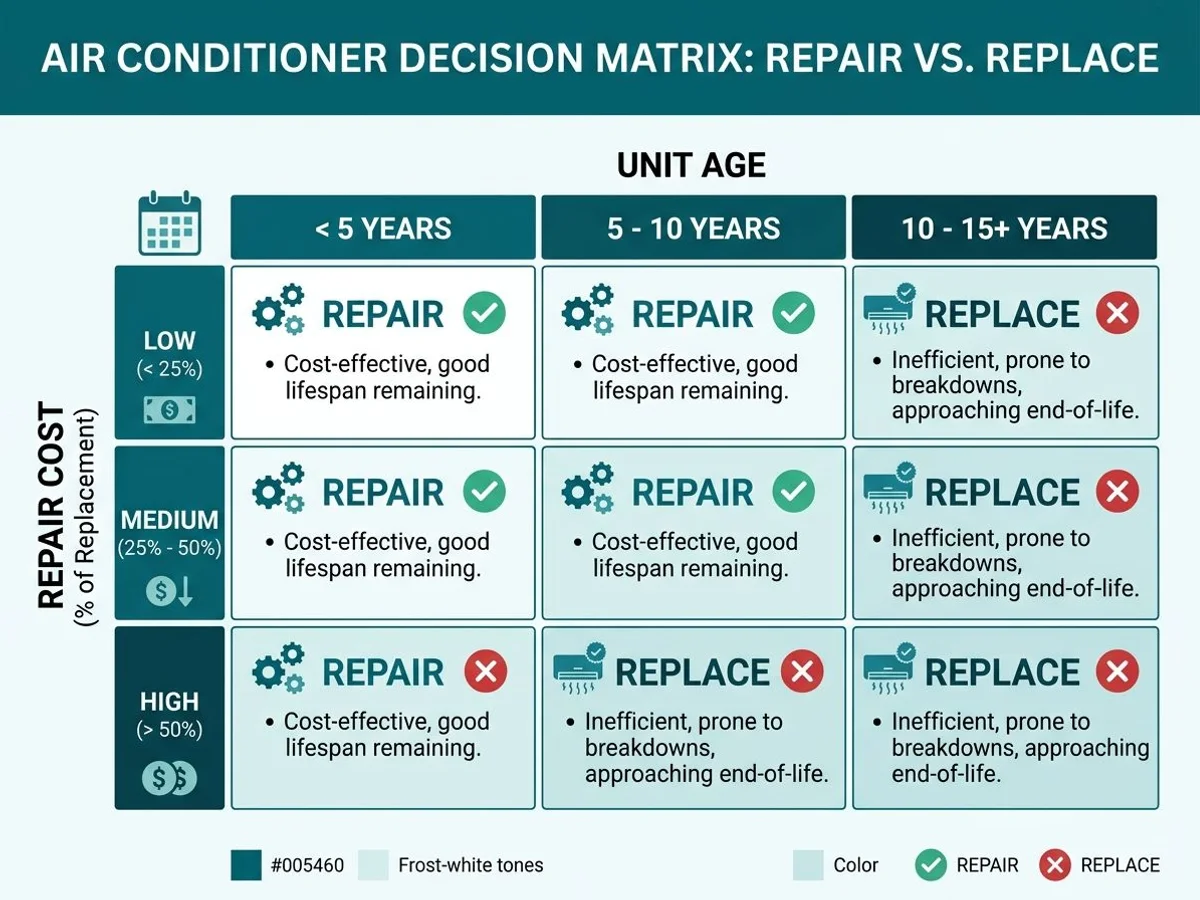
- Under 5 years: Repair any reasonable fault. The system still has years of productive life ahead.
- 5 to 8 years: Proceed with repairs if the total cost stays under 30 to 40 percent of a new replacement.
- 8 to 10 years: Apply the strict half-cost rule before approving any work.
- 10+ years: A full replacement is almost always the smartest move for anything beyond a basic service. Older internal components are actively degrading by this stage.
2. Recurring vs one-off fault
A single component failure on an otherwise healthy system justifies a simple repair. A clear pattern of consecutive breakdowns means the entire unit is reaching its breaking point.
We frequently see units suffer a blown capacitor one year, a strained compressor the next, and a refrigerant leak shortly after. That compounding failure rate is a massive red flag.
Repeated emergency calls cost you far more than a planned replacement.
3. The specific part failing
The exact component that fails heavily influences the financial logic of fixing it. Certain breakdowns signal total system failure, while others are just cheap maintenance items.
Our technicians check specific parts to gauge the general health of the system.
- Compressor failure: This acts as the final death knell. A replacement compressor easily costs RM800 or more, and a failure near year 10 guarantees other major faults will follow.
- Coil leak or pinhole: These sit in the middle ground. Technicians can repair them, but the leak indicates advancing corrosion throughout the copper lines.
- Wear parts: Capacitors, fan motors, sensors, and thermostats fail naturally over time. Replacing a RM150 capacitor does not mean your aircon is dying.
- PCB (control board): New boards range from RM400 to RM800 depending on the brand. The age of the unit determines if this steep price is worth paying.
4. Energy efficiency of the current vs new unit
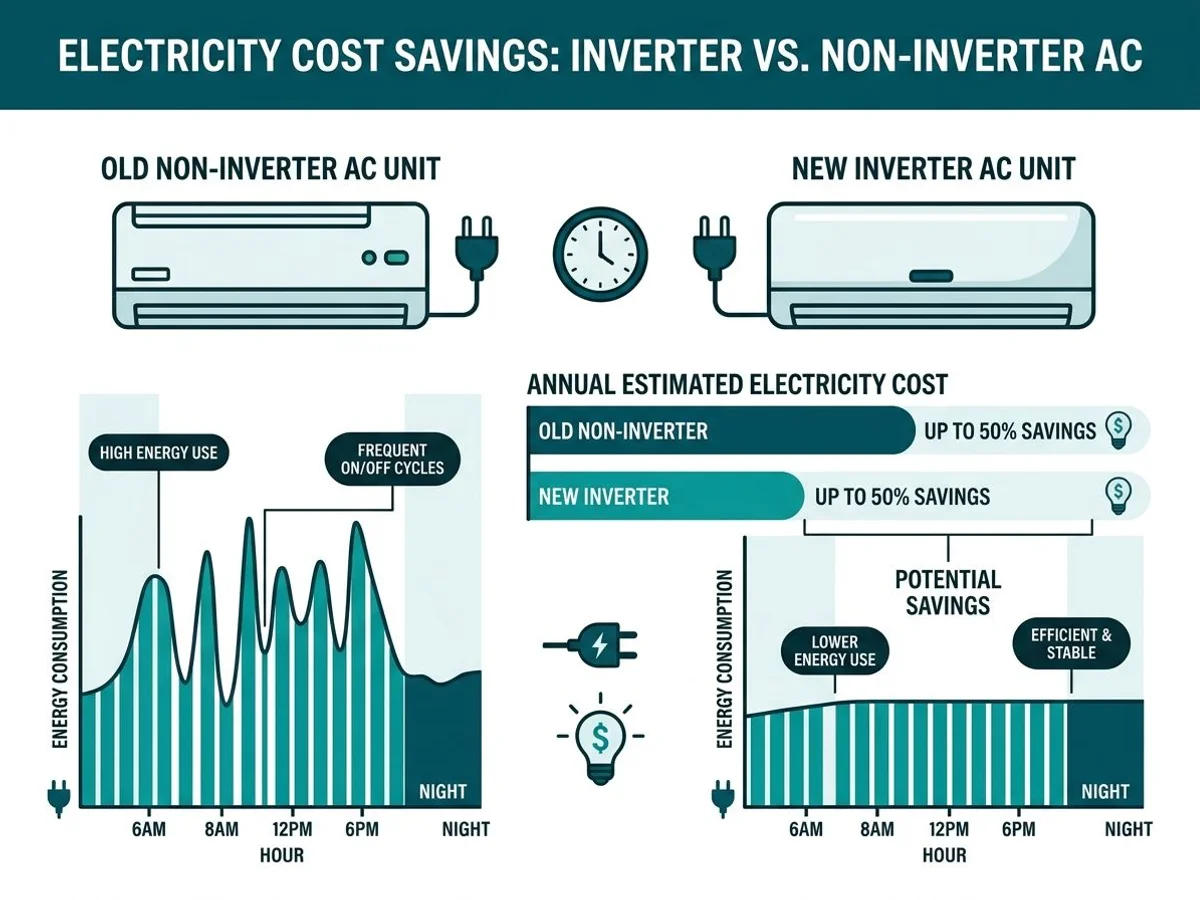
Older non-inverter models consume significantly more electricity than modern inverter equivalents. An outdated 1.5 HP system draws around 1,300 to 1,500 watts constantly, pushing many Malaysian homes into the expensive 51.6 sen per kWh TNB tariff tier.
Our calculations show that a new inverter model provides immediate financial relief.
- Reduced Consumption: Cooling costs drop by up to 40 percent.
- Monthly Savings: Running a unit for 8 hours a night saves RM50 to RM100.
- Payback Period: These TNB savings pay off the new inverter within two to four years.
Spending RM800 to fix an old power-hungry system rarely makes mathematical sense. We always remind customers to look at the long-term utility bills before repairing an outdated machine.
5. Maintenance history
A consistent service record drastically extends the viable lifespan of any cooling system. Units receiving chemical washes every six to twelve months handle the harsh Penang humidity much better and remain worth fixing.
Our service logs prove that neglected machines degrade much faster. A heavily choked, unserviced system is already close to complete failure regardless of its actual age.
Pouring money into a major repair on a poorly maintained machine is a bad investment.
The repair scenarios we usually recommend
Certain breakdown situations clearly favour a fast and targeted repair. You should save your money and fix the current unit under these specific conditions.
Our daily service routes involve handling these exact minor fixes efficiently.
- 3-year-old unit with a failed capacitor: Approve the repair immediately. It costs roughly RM200 to RM250 and takes just 30 minutes to resolve.
- 5-year-old unit with a flare joint refrigerant leak: Repairing the joint and topping up the gas costs around RM250.
- 7-year-old unit with fan motor failure: Fix the motor if the quote is RM400 or less. Start shopping for a replacement if the price climbs higher.
The replacement scenarios
Specific red flags indicate that a system is beyond saving. You must replace the aircon when these severe issues arise to prevent wasting money.
Our installers handle replacements immediately when we encounter these dealbreakers.
- 8+ years old with compressor issues: The repair costs nearly rival a brand-new unit, and fixing it just keeps an inefficient machine running.
- 12-year-old system with PCB failure: Even if the compressor still works, the surrounding components are on borrowed time.
- Multiple major faults within 12 months: The system is actively deteriorating.
- R22 refrigerant units: The government ceased R22 imports in 2020 ahead of a full ban. Getting recycled R22 gas is incredibly expensive, making replacement the only logical step.
- Advanced coil corrosion: Visible rust and flaking on the outdoor condenser means the structural integrity is gone.
What we do during a repair quote
A professional diagnosis should provide complete transparency regarding your options. You need hard facts and clear numbers to decide whether to repair or replace your aircon.
Our technicians refuse to just hand over a high repair bill without context. A thorough evaluation covers all the financial angles.
- The exact cost of the required repair and the specific warranty attached to that work.
- The total price of installing a similar capacity modern inverter system.
- The estimated monthly TNB electricity savings comparing the two options.
- The realistic remaining lifespan of your current equipment if you proceed with the fix.
We leave the final decision entirely in your hands. Sometimes a quick fix is genuinely the most logical choice.
Providing an honest assessment prevents you from sinking cash into a doomed machine.
Trade-in program
Old and broken air conditioning units still hold residual scrap value. Utilizing a trade-in option reduces the total cost of installing your new system.
Our installation packages include a direct credit for your old equipment. Even completely dead units carry an e-waste value of RM50 to RM200 in the Penang market, depending on the specific brand and condition.
Simply snap a photo of the old system when requesting a replacement quote. We will factor that trade-in value directly into your final installation price.
Booking
Securing a professional diagnosis is the necessary first step before making any large financial decisions.
Having a technician inspect the unit gives you the exact numbers required to move forward. You do not have to commit to a specific path right away.
Our team will uncover the root cause first so you can weigh the real costs of an aircon repair vs replacement.
Book a repair diagnosis to get started today.