
Inverter vs Non-Inverter Aircon — TNB Bill Impact
Inverter vs non-inverter aircon for Malaysian homes: how inverters modulate, TNB running-cost breakdown by HP, and the ROI over time.
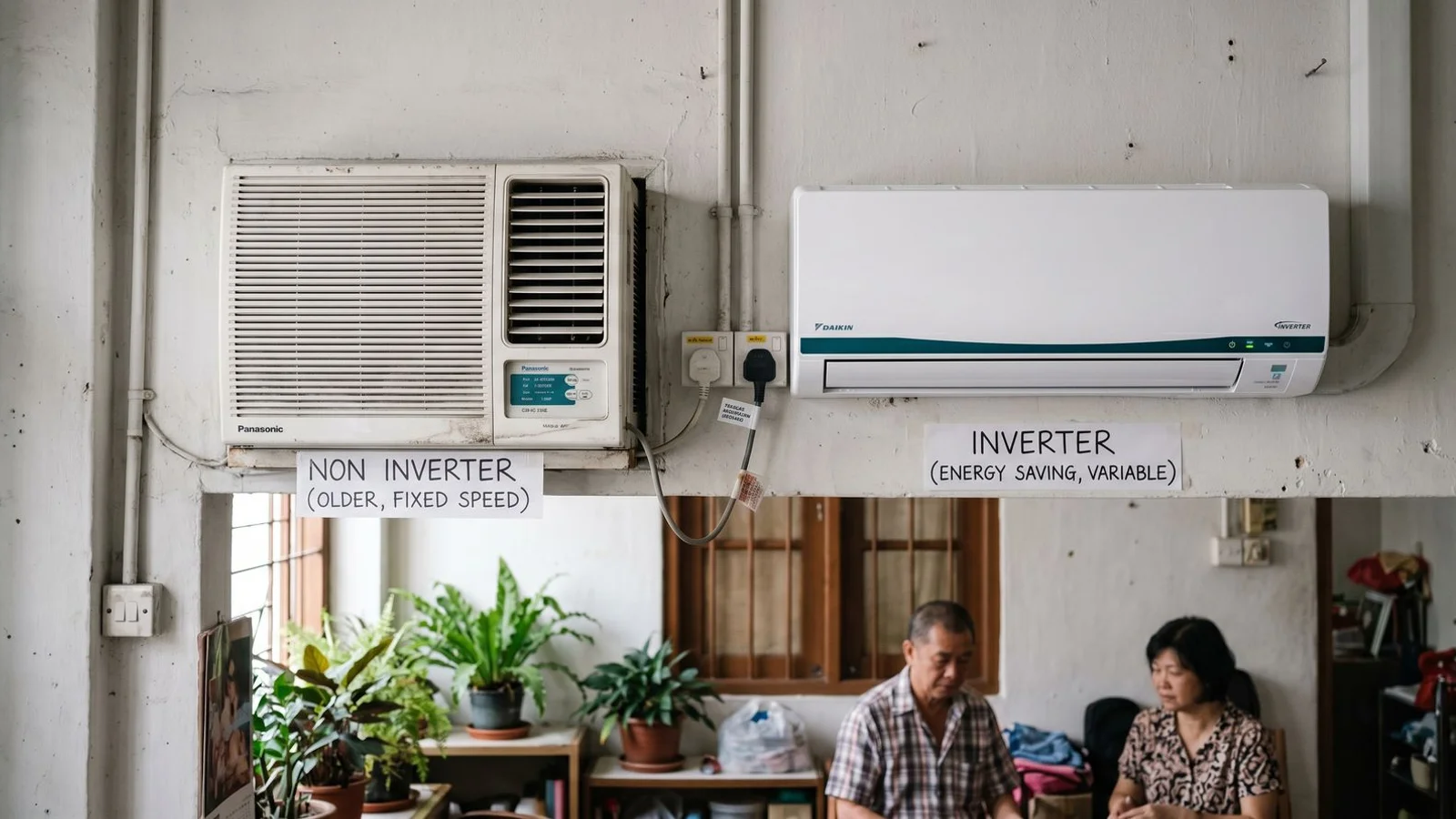
You know how everyone always asks about the inverter vs non inverter aircon malaysia comparison, and if the premium is actually justified?
Our team at PG1 Aircond has spent over 15 years answering this exact question across Penang. The sheer volume of marketing noise makes it hard to see the real financial impact.
We track the actual data, monitor the TNB bills, and handle the real-world repairs. This level of daily exposure allows us to see exactly where the money goes.
We are going to break down the mechanical differences and show you the real numbers. Then, the data will clearly show when an inverter makes sense and when a basic unit is the smarter choice. Once you’ve settled the inverter question, our guide to the best aircon brands in Malaysia helps you pick a model.
The mechanical difference
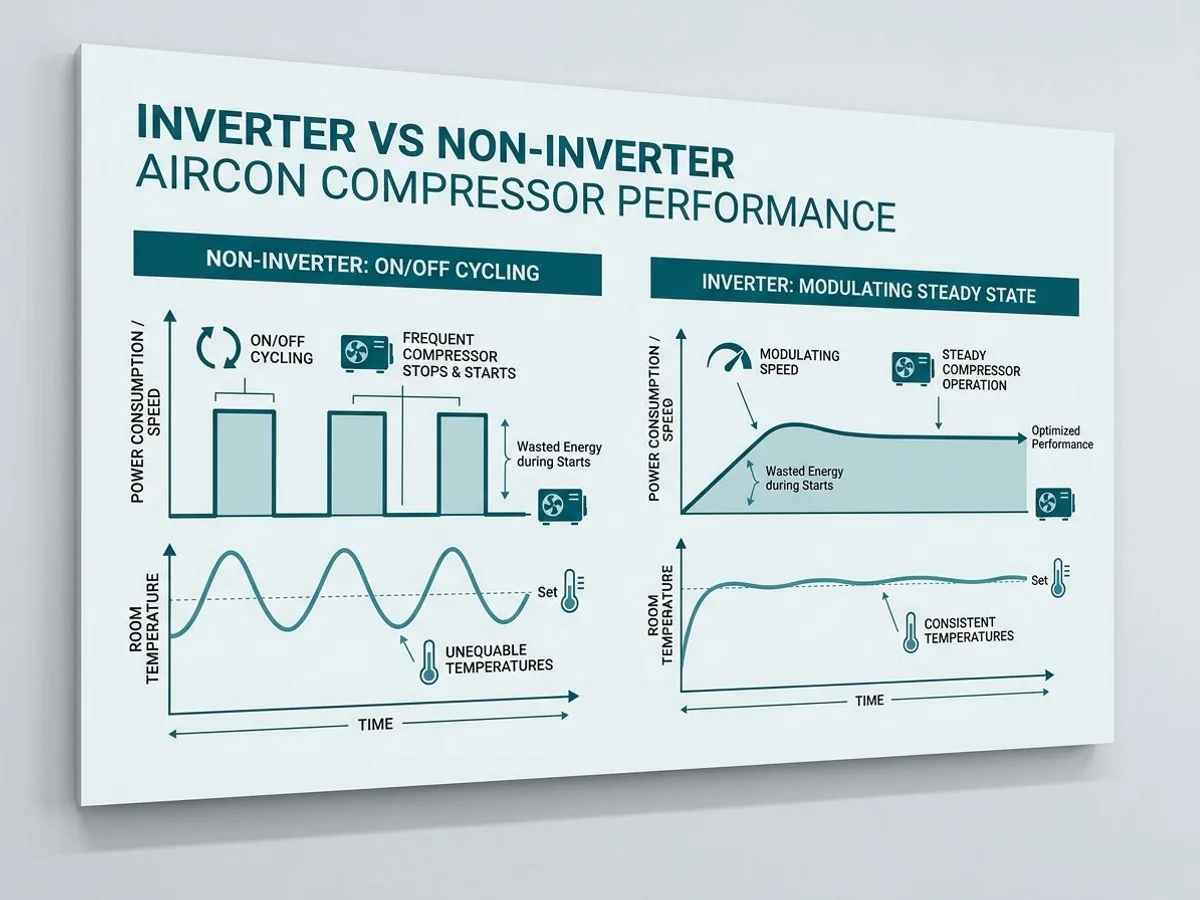
The core difference lies in how the compressor operates to manage your room temperature. A conventional unit cycles fully on and off, while an inverter constantly adjusts its motor speed to maintain steady cooling. Our field technicians often explain this to customers by comparing the actual temperature swings in the room. We see the impact of these two distinct cooling methods every single day.
Non-inverter (conventional) aircon:
- The system uses a fixed-speed rotary compressor that runs at full power.
- Once the room hits the target temperature, the compressor switches off completely.
- The room warms up by 2 or 3 degrees Celsius before the compressor restarts.
- This creates a continuous, high-energy cycle of stopping and starting.
Inverter aircon:
- A variable-speed compressor adjusts its workload based on the room conditions.
- After the initial rapid cooling phase, the motor slows down automatically.
- The system never fully shuts off, which maintains the temperature within a tight 0.5-degree margin.
- You get steady, even cooling without sudden blasts of cold air.
Our team always points out that this variable-speed approach requires less raw power over time. It represents a fundamental shift in how modern cooling systems operate.
Why inverters save power
We see a massive difference in energy consumption because inverters avoid power-hungry stops and starts. They maintain your room temperature by running continuously at a very low, efficient speed. Reducing your total kilowatt-hour usage is crucial because the inverter vs non inverter tnb billing impact is massive under the progressive tariff system.
- No high-current starting surges. Every time a conventional unit cycles on, it draws a massive spike of electricity. Inverters completely avoid this power surge by modulating their speed instead of stopping.
- Lower steady-state power. A modern inverter runs at roughly 30 to 40 percent of its maximum capacity once the room cools down. The non-inverter is stuck running at 100 percent, which averages out to a much higher daily consumption.
- Better part-load efficiency. Cooling systems operate most efficiently when they are not pushed to their absolute limits. Inverter units spend most of the night at a low load, which is the exact sweet spot for energy efficiency.
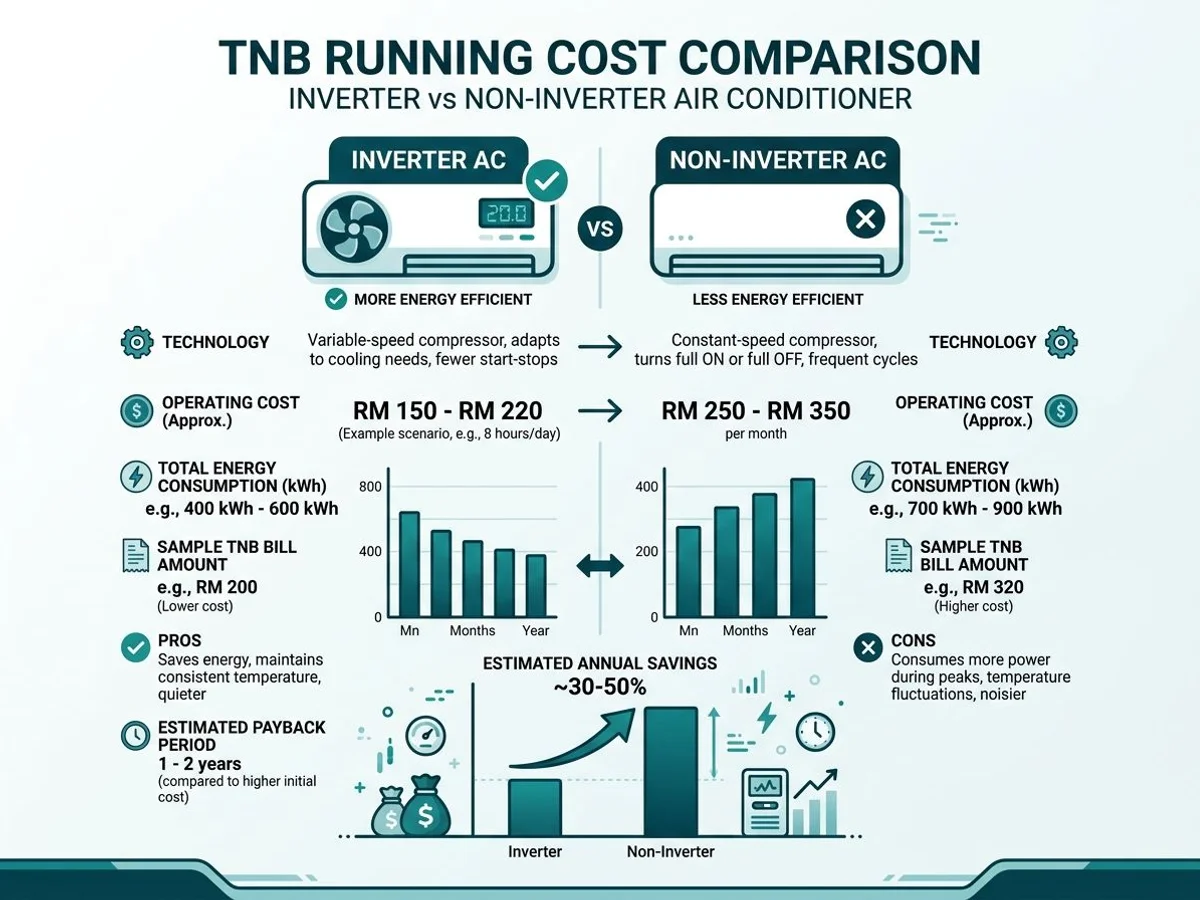
Our recent data shows this creates a net reduction of 30 to 50 percent in electricity usage for the same cooling output. Keeping your consumption low means you stay closer to the cheaper 21.80 sen per kWh TNB domestic block, avoiding the harsh penalties of higher tiers.
The TNB math by HP
We calculate the monthly running costs based on typical evening usage in Penang, and the data clearly favors the newer technology. An inverter saves you roughly RM45 per month on a standard 1.5 HP unit used for six hours every night. Our estimates below highlight the standard financial impact you can expect.
| HP | Non-Inverter | Inverter | Monthly Saving |
|---|---|---|---|
| 1.0 HP | RM75 | RM45 | RM30 |
| 1.5 HP | RM110 | RM65 | RM45 |
| 2.0 HP | RM150 | RM90 | RM60 |
| 2.5 HP | RM200 | RM120 | RM80 |
These figures represent rough averages for standard residential setups. Heavy users who run their units for eight hours or more will naturally see much larger absolute savings. Our light users might only notice a small dip in their monthly expenses.
Price premium and payback
We track the upfront costs closely, and a standard 1.5 HP inverter from a top brand generally costs about RM400 to RM500 more than a basic unit. This initial investment typically pays for itself through TNB bill savings within 9 to 11 months.
Here is the current 2026 market breakdown for a standard 1.5 HP wall split unit:
- Non-inverter: RM1,050 to RM1,300.
- Inverter: RM1,400 to RM1,700.
We calculate the return on investment for a regular master bedroom used six hours a night. The math makes the decision incredibly straightforward:
- Monthly saving on the TNB bill: RM45.
- Estimated premium to recover: RM400 to RM500.
- Expected payback period: 9 to 11 months.
Our clients continue to save RM45 every single month for the remaining 8 to 10 years of the system’s lifespan. This creates a total lifetime return of over RM4,000 per unit, which perfectly illustrates real inverter aircon savings. Daily-use spaces like living rooms and master bedrooms make the upgrade an absolute necessity.
When non-inverter still makes sense
We certainly do not push premium technology for every single room in a house. A basic conventional unit remains the smartest financial choice for guest rooms or holiday homes that see very little use. Our team regularly advises against inverters in a few specific scenarios.
The financial math simply stops working for:
- Occasional-use rooms. A guest bedroom used only twice a month will never accumulate enough savings to justify the cost.
- Holiday homes. Properties in areas like Batu Ferringhi with very low total annual runtime do not benefit from efficiency upgrades.
- Tight upfront budgets. The immediate RM500 premium might be a larger barrier than the slow RM45 monthly penalty.
- Rental properties. Landlords who pay for the installation have zero economic incentive to upgrade if the tenant covers the TNB bill.
We find that a basic conventional unit works perfectly fine for these specific situations. It provides reliable cooling without the unnecessary upfront premium.
Other inverter advantages
We look beyond just the financial savings when evaluating complete home comfort. Inverter technology provides a much quieter operation and completely eliminates the annoying hot and cold temperature swings. The underlying hardware provides several daily benefits that dramatically improve your living environment. Our customers often mention these secondary perks more than the lower electricity bills.
The main operational advantages include:
- More comfortable sleep. You get a consistent temperature without the annoying hot and cold swings.
- Significantly quieter operation. High-quality units can drop down to a near-silent 20 decibels, completely eliminating the loud startup roar.
- Superior humidity control. The system runs long enough to properly extract moisture from the humid Penang air.
- Longer compressor life. Avoiding constant electrical spikes puts far less mechanical stress on the core components.
- Lower starting current. This gentle power draw is much safer for older houses with aging electrical wiring.
Your family will notice these quality-of-life improvements immediately. They represent a massive upgrade over older cooling methods.
Disadvantages of inverters
We believe in full transparency regarding the potential drawbacks of advanced cooling systems. The biggest risk is the complex electronic circuit board, which can cost between RM450 and RM800 to replace if it gets damaged. Our repair logs highlight the most common issues you might face.
The primary disadvantages to consider are:
- Higher initial purchase price. The upfront cost is undeniably steeper.
- Expensive specialized repairs. If the Printed Circuit Board fails, a replacement usually costs between RM450 and RM800.
- Sensitivity to electrical issues. Frequent lightning storms and power fluctuations in Malaysia can easily fry a delicate inverter board.
- Vulnerability to pests. Common house lizards love the warmth of the outdoor circuit boards and frequently cause expensive short circuits.
We manage the circuit board risk carefully, but it is not the dominant factor in most homes. Modern installations feature better surge protection to mitigate electrical damage. Our data shows that only 5 to 10 percent of the inverter units we install require board replacements over a seven-year period. The vast majority run completely trouble-free for their entire expected lifespan.
What we recommend in Penang
We design our cooling strategies to match the specific layout and routine of each household. You should install inverters in daily-use spaces like master bedrooms, and stick to basic units for spare rooms. Your daily schedule dictates exactly which technology will perform best. Our standard recommendations reflect the most successful setups we install across the state.
Here is how we typically assign units based on room function:
- Master bedroom with daily use. The fast payback makes an inverter mandatory.
- Living room with daily evening use. The high usage hours demand an inverter.
- Kids’ bedrooms with daily use. The quiet operation and savings justify an inverter.
- Guest bedroom with occasional use. A cheaper non-inverter is the smartest move.
- Office or retail shop. Heavy business hours make the inverter savings highly significant.
- Server room. 24/7 cooling requires the absolute best energy efficiency available.
We frequently design mixed installations for larger family homes. Placing a premium unit in the master suite and a basic unit in the spare room provides the perfect balance of comfort and budget control.
What about Eco mode on non-inverters?
We frequently get questions about the special energy-saving buttons found on cheaper units. This mode restricts the compressor to smaller power bursts, but it never reaches the true efficiency of a real variable-speed motor. Some conventional models feature this setting to mimic advanced behaviour.
Our testing shows this mode offers a minor improvement, but it never matches true inverter performance. This feature is quite useful if you already own a basic unit and want to trim a few Ringgit off your bill. You should never buy a conventional unit solely because it has this button, as the underlying hardware remains exactly the same.
Booking
We always begin the process with a thorough site visit to assess your property.
Proper measurement and a clear understanding of your habits ensure we recommend the perfect equipment. Our technicians will map out the ideal mix of technologies customised specifically for your home.
You can review our full process and pricing directly on our installation service page. We handle everything from the initial consultation to the final testing to guarantee maximum efficiency.