
Why Installers Use OFN Pressure Test and Vacuum
Why a 30 Bar OFN pressure test and 2-hour vacuum matter for a leak-free aircon install — and why skipping them voids your warranty.
If you have ever asked an aircon technician why one quote costs so much more than another, the answer usually comes down to two invisible steps.
Cheaper installers often skip the OFN pressure test aircon vacuum procedures entirely to save time.
We see the fallout from these rushed jobs every week across Penang. This shortcut might seem harmless at first. These checks are part of the full aircon installation process, and here we explore exactly what they are and why skipping them is a costly mistake.
What OFN actually is
OFN stands for oxygen-free nitrogen. This is regular nitrogen gas with the oxygen content reduced below 1%.
We rely on this specific gas for two very important reasons. First, it is completely inert and will not react with the copper piping or compressor oils inside your aircon system. Second, it contains zero moisture.
Dryness is critical for a successful pressure test.
Industrial gas suppliers in Malaysia, such as Linde, provide this high-purity nitrogen in heavy compressed cylinders.
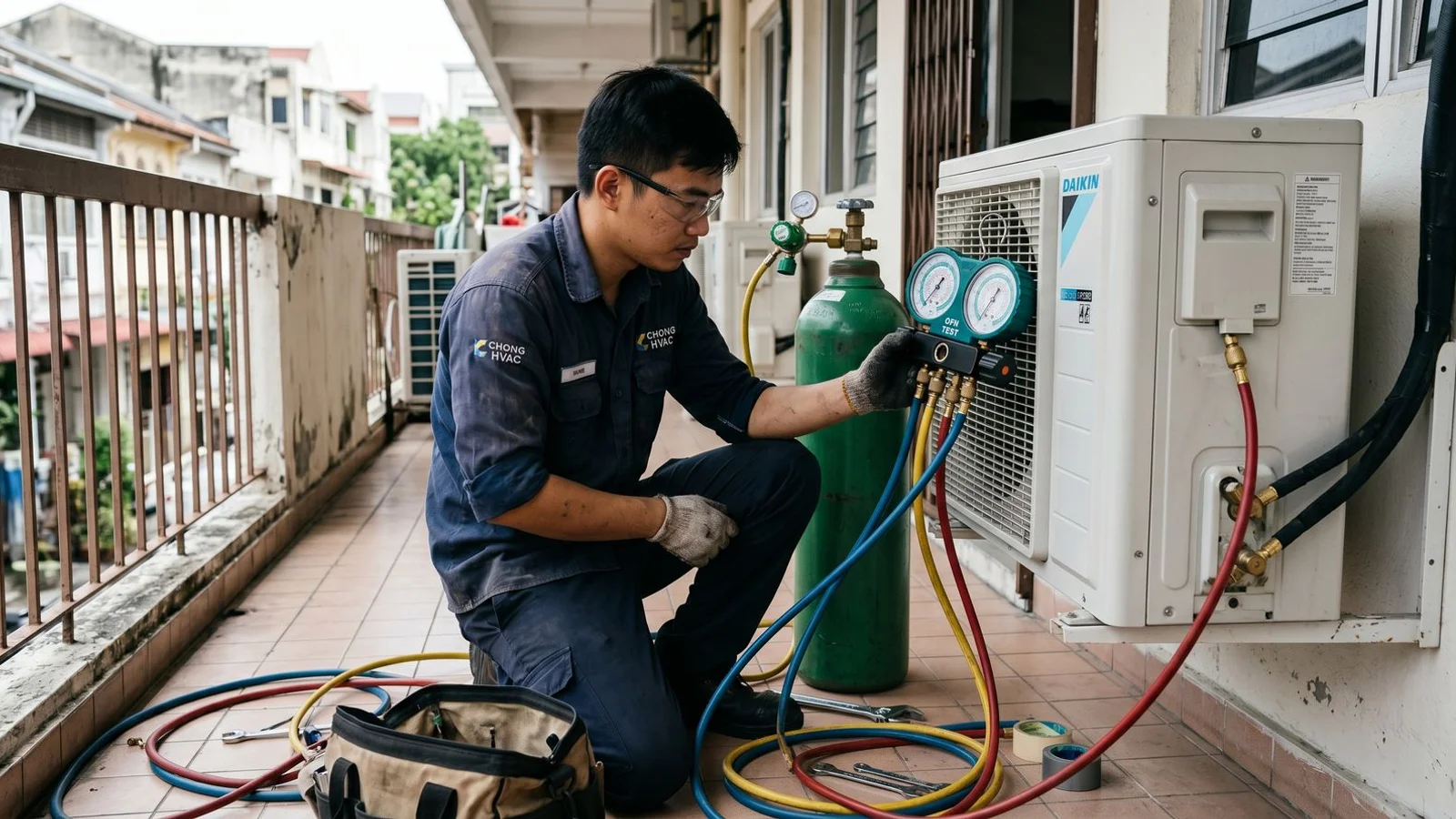
Our technicians use a specialised pressure regulator and manifold gauge set. These tools allow them to precisely control the extreme pressure entering your aircon lines.
The pressure test, step by step
This critical test happens immediately after the copper piping is installed and connected at both ends. It proves the system is completely sealed before any refrigerant enters the loop.
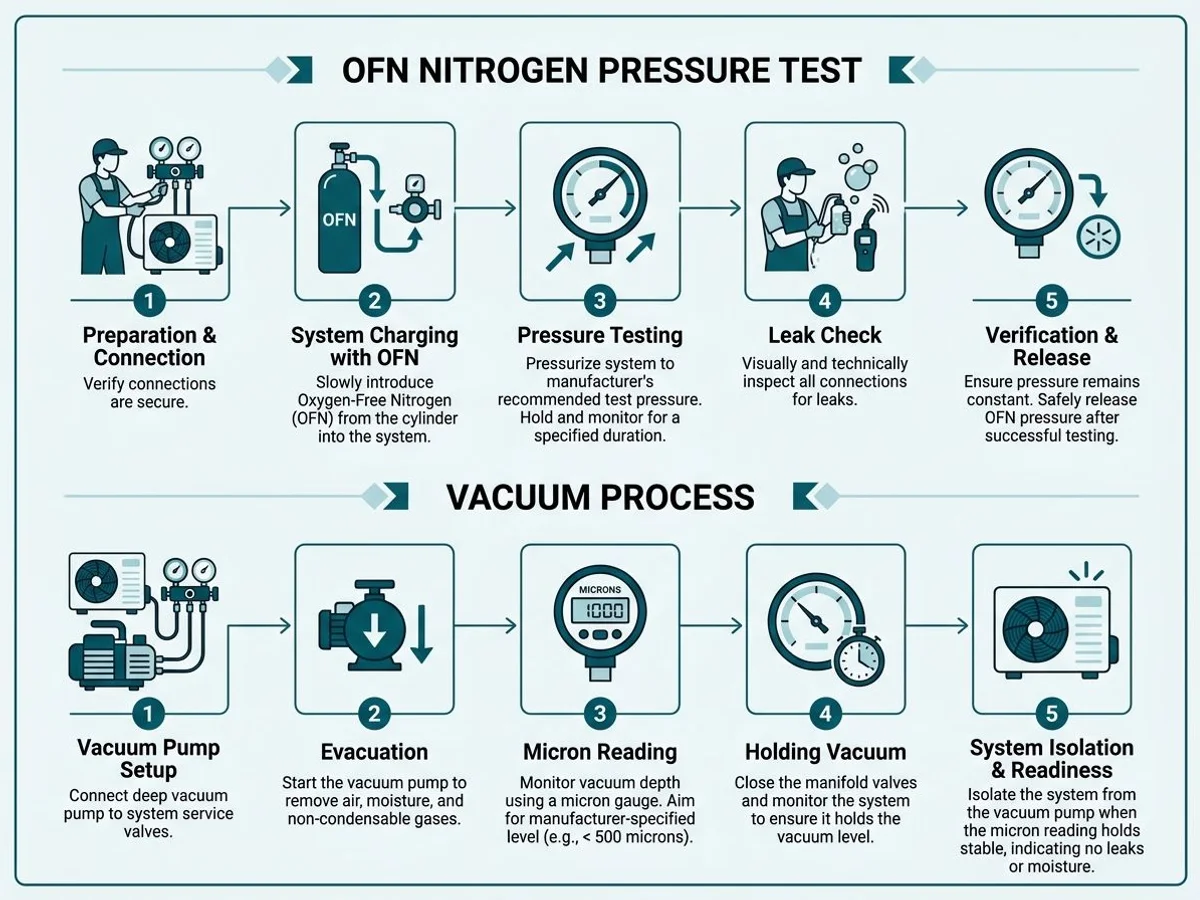
We follow a strict sequence to ensure your system is entirely leak-free.
- Seal both ends: The indoor and outdoor unit valves remain securely shut.
- Connect the OFN cylinder: Technicians attach it to the service valve using a manifold gauge.
- Slowly raise pressure: We push the nitrogen up to 30 Bar (about 435 psi).
- Isolate the line: The cylinder is disconnected, leaving the pipe sealed and pressurised.
- Hold and monitor: We watch the gauge carefully for 15 to 30 minutes.
- Investigate drops: Any pressure loss indicates a leak.
If the gauge needle drops, the team hunts down the fault. They might use a micro-leak detector fluid like Big Blu on the flare joints. For hidden areas, a digital refrigerant leak detector from brands like Fieldpiece helps pinpoint the exact flaw.
They fix the issue and repeat the entire pressurisation process. The installation only moves to the vacuum phase if the pressure holds perfectly steady. This rigorous routine catches dodgy welds and cracked pipes early. Skipping this means your unit will slowly lose its R32 refrigerant over the coming months.
Why 30 Bar specifically?
We test at 30 Bar because it represents an extreme stress level that exposes any weak joints. The normal operating pressure of a modern R32 aircon system in Malaysia sits between 7 and 15 Bar during regular cooling.
Testing at double the normal working load is a proven safety measure. It ensures your flare joints will survive years of constant thermal expansion and contraction.
Major manufacturers mandate these high-pressure nitrogen tests. For instance, Daikin Malaysia’s latest technical guidelines for R32 inverters specify pressure testing at up to 41.5 Bar for complete assurance.
- It reveals tiny flaws that hold tight at standard pressure.
- It meets strict ASHRAE global industry standards.
- It secures your official manufacturer warranty.
A low-pressure test of just 5 or 10 Bar is practically useless. It only catches massive, obvious holes while missing the microscopic weeps that ruin your system slowly.
The vacuum, step by step
The aircon vacuum process happens right after the pressure test passes, designed to suck all air and moisture out of the sealed pipes. This step creates a completely empty void inside the copper lines.
We use a precise, multi-step method to achieve this deep evacuation.
- Release the nitrogen: All OFN pressure is vented safely into the atmosphere.
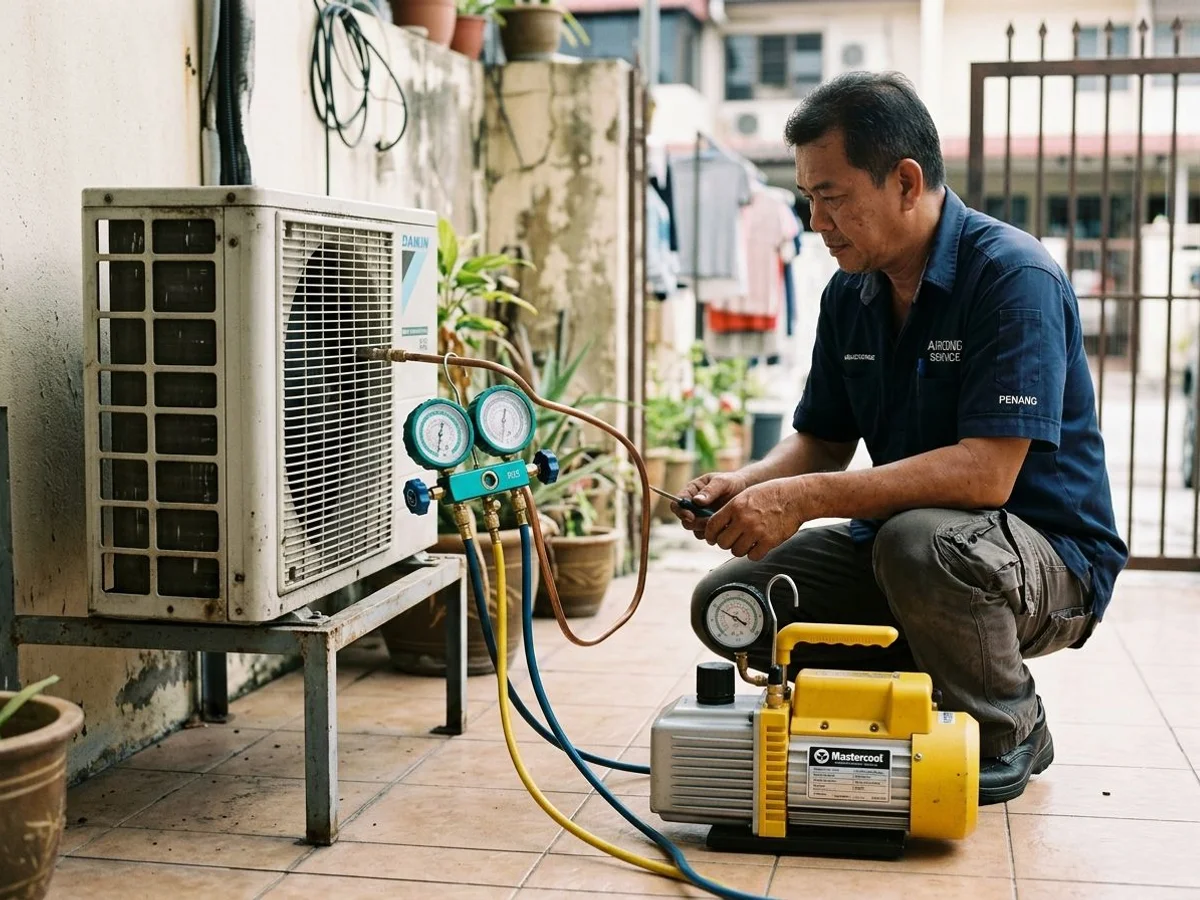
- Attach the pump: A heavy-duty vacuum pump connects to the service valve.
- Run the machine: The pump operates until a digital gauge reads below 500 microns.
- Hold the vacuum: This deep state is maintained for at least two hours on standard residential units.
- Secure the system: Technicians close all valves and detach the pumping equipment.
- Final leak check: They wait another 15 minutes to ensure the deep vacuum does not break.
- Release the charge: The service valves open to let the factory R32 refrigerant flow into the clean, empty pipes.
Losing vacuum during that final wait is incredibly rare if the previous nitrogen test passed. It acts as the ultimate final check before commissioning your new cooling unit.
Why vacuum matters
Creating a deep vacuum is vital because you absolutely must keep two specific contaminants out of your refrigerant lines. Leaving them inside will destroy your new investment from the inside out.
Moisture
Even a single microscopic drop of water trapped in the line is catastrophic for a modern aircon. Modern inverter units use specialized synthetic lubricants like POE (Polyolester) oil.
This POE oil is highly hygroscopic, meaning it acts like a sponge and actively absorbs any moisture left in the pipes. When water mixes with POE oil under high heat, it triggers a chemical reaction called hydrolysis.
This reaction creates potent internal acids. These acids aggressively corrode the compressor motor windings, copper plating, and internal steel valves.
- Internal parts rust quickly.
- Sludge forms and blocks narrow capillary tubes.
- The compressor easily shorts out completely.
Replacing a burnt-out inverter compressor in Penang will cost you RM1,500 to RM3,000 today. Paying a slight premium for a proper vacuum installation saves you from this massive repair bill down the road.
Air
Air left in the line acts as a non-condensable gas that severely disrupts the entire cooling cycle. Normal atmospheric air simply does not condense into a liquid inside the condenser coil like R32 refrigerant does.
This trapped air takes up valuable space inside the system. It forces the compressor to work twice as hard to pump the same amount of heat.
- Your cooling capacity drops noticeably.
- Internal operating pressures spike dangerously high.
- The unit draws significantly more electricity.
That loss of efficiency directly impacts your wallet. In Malaysia, residential electricity is billed in tiered blocks by TNB. A struggling, air-filled system will quickly push your monthly usage into the expensive 51.60 sen per kWh penalty block.
Why “quick vacuum” doesn’t work
A quick 15-minute vacuum fails because moisture takes significant time to boil off and vaporise at low atmospheric pressures. Many cheap installers will simply connect a small pump, wait a few minutes, and falsely declare the line evacuated.
The science behind this process cannot be rushed. As the vacuum pump removes air, the internal pressure drops, which lowers the boiling point of trapped water.
At an industry-standard deep vacuum of 500 microns, water boils at roughly -24 degrees Celsius. Even at this extreme negative pressure, the actual evaporation is a painfully slow process.
A brief 15-minute run clears out the ambient air but leaves a heavy coating of moisture clinging to the copper walls. Your newly installed unit might run perfectly for 12 to 24 months.
- The trapped moisture remains hidden inside.
- Acid formation silently begins within the POE oil.
- Early compressor death becomes inevitable.
Our mandatory two-hour hold gives that stubborn moisture the time it needs to fully turn into a gas and exit the system. It certainly makes the installation take longer. This patience guarantees your system lasts for a decade instead of a year.
The warranty connection
Major aircon brands explicitly require documented OFN pressure testing and a deep vacuum process to keep their factory warranties valid. Companies like Daikin, Panasonic, and Mitsubishi heavily scrutinise premature compressor failures.
Most premium inverter units sold in Malaysia now include a 5-year or even 10-year compressor warranty. These generous guarantees come with very strict installation conditions attached.
If your compressor seizes up in year three, the manufacturer will send a technician to extract an oil sample. They perform an acid analysis on this oil to check for severe moisture damage.
- Evidence of acid immediately voids the warranty.
- The manufacturer officially rejects the claim.
- You are forced to pay the full replacement cost out of pocket.
We actively log our nitrogen test pressures and exact vacuum holding times on every job sheet. This precise documentation ensures you have the necessary proof to support any future warranty claims without hassle.
How to tell if your installer did it properly
You can verify the quality of your installation by asking your technician three specific questions before they pack up their tools. Their answers will instantly reveal if they followed the correct safety protocols.
Always request this information while they are still on your property.
- “What exact pressure did you test at, and how long did you hold it?” The only acceptable answer is 30 Bar or higher, held for at least 15 minutes.
- “How many hours did the vacuum pump run?” The right answer is two hours or more for a standard residential split unit.
- “Can I please get a physical copy of the pressure test record?” A professional will gladly hand over the completed paperwork.
If the technician hedges, stammers, or makes excuses, you are almost certainly looking at a rushed job that skipped crucial steps.
For an installation done properly from the very start to the final handover, see our installation service page for what is included and how we quote.